
Consistency is harder than it sounds, and it’s also one of the most satisfying things to get right. Anyone can roast a good batch of coffee — nail the timing, pull it at the right moment, and you’ve got something worth drinking. But doing it again tomorrow, and the next day, and in July when the humidity’s up, and in January when the shop is cold at 4am and the roaster takes longer to get going — that’s where it gets interesting. That’s the puzzle we’ve been solving, and I want to tell you how we do it.
How We Build a Batch
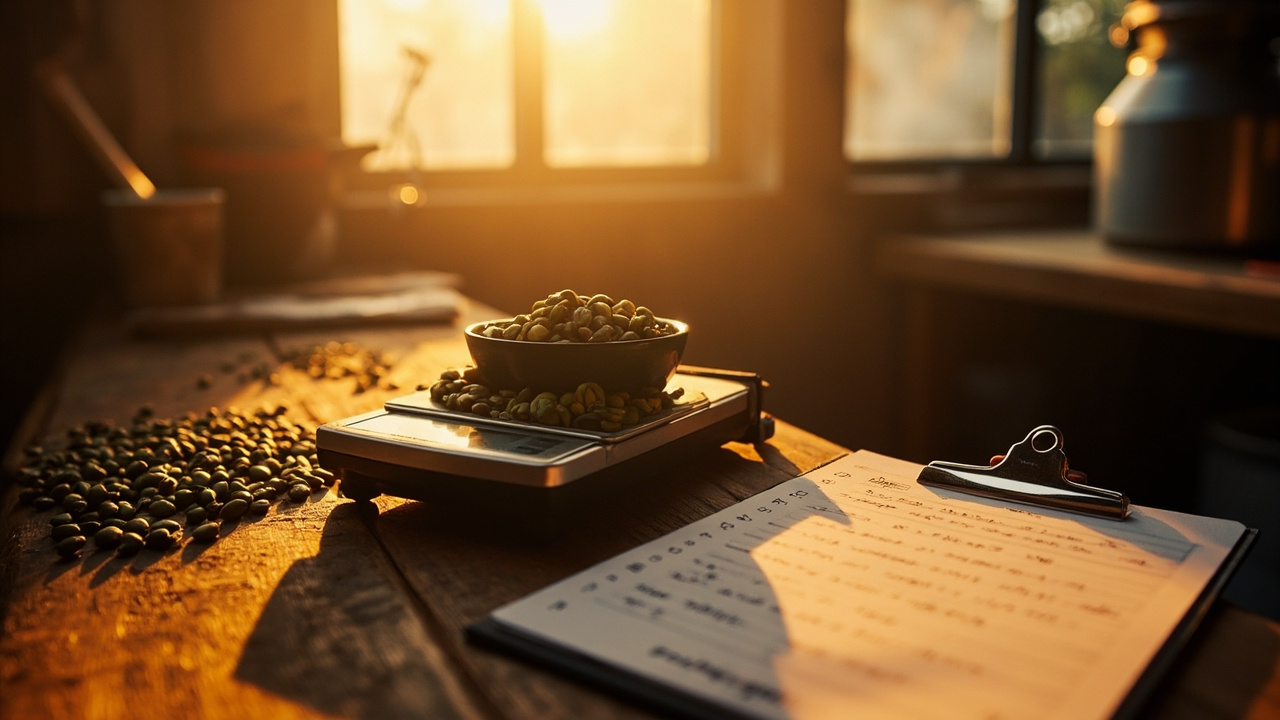
Every roast starts with green coffee measured to the gram. For our house blend, we’re combining multiple origins in specific ratios, and getting those ratios right matters more than you’d think. A few grams off here, a few there, and the cup starts to drift. So we measure everything, and I mean everything.
We’ve got these automated dosing systems — literal bean counting machines — and honestly, they’re a joy to use. Each origin gets weighed out according to the recipe, drops into a hopper, and combines into a roast canister. Two kilograms of green coffee, precisely measured, ready to roast. Sometimes we do it by hand with precision scales when the situation calls for it, and there’s something satisfying about that too. Either way, every batch gets a batch ID, and we track those beans from that moment forward. It sounds nerdy because it is nerdy, but this is how you build something repeatable.
Roasting and Watching
Every batch follows a programmed curve — temperature targets over time that we’ve developed through months of testing and tasting. We monitor drum temp, bean temp, rate of rise, airflow. First crack comes when it comes, but we know roughly when to expect it. The curve is the plan, and the monitoring is how we make sure reality matches the plan.
Here’s the thing about coffee: it doesn’t always cooperate, and that’s actually part of what makes this interesting. Ambient temperature shifts between seasons, humidity changes with the weather, and beans from this harvest might be slightly denser than the last shipment. The curve gives us a target, but the roaster has to adapt in real time. That’s why we watch everything as it happens, making small adjustments to land where we want to land. When the roast is done, the beans drop into the cooling tray, and that’s when the real measurement happens.
The Number That Matters
Once a batch cools, we pull a sample and run it through a dedicated grinder — same grinder, same settings, never changes. Consistency in measurement requires consistency in preparation. The ground sample goes into our Agtron colorimeter, which bounces light off the coffee and gives us a number. It’s a precise measurement of roast level based on how the surface reflects light. Lower numbers mean darker roasts, higher numbers mean lighter. If you’ve never seen one of these work, it’s genuinely cool — you’re getting objective data about something that used to be pure guesswork.
We love this thing. Before we got it in mid-2025, we were good — we knew our roaster, we knew our beans, and we could get close. But “close” meant some batches came out a little lighter, some a little darker. The regulars might notice. We definitely noticed. Now we have an actual number, and we track it against every batch we’ve ever roasted. Our target for the house blend is to hit within a couple Agtron points every single time. Some days the weather fights us, some days the beans have more moisture than we expected, but we adjust and monitor and hit the number anyway. There’s real satisfaction in that.
Why This Matters to Us
Coffee is agricultural, which means it’s variable by nature. The same farm, same varietal, same processing method — it still shifts from harvest to harvest. The weather in Honduras affects what ends up in your cup here in Hoquiam. Our job is to absorb that variability, to take beans that are slightly different each time and produce coffee that tastes the same each time. That’s what consistency really means: not identical inputs, but identical outputs. And when you can do that reliably, week after week, you’ve built something you can stand behind.
The Agtron reading is our anchor. Everything else can shift — new crop, different moisture levels, equipment that just got cleaned — but that number tells us whether we landed where we meant to land. And when something changes, we don’t have to guess whether we’re still dialed in. We measure, we compare, we adjust if we need to. The batch logs help us learn too. Maybe the numbers drifted and we didn’t catch it. Maybe the new crop roasts differently than we expected. Either way, every batch teaches us something, and we keep the records so we don’t forget. That’s how you get better over time.
People sometimes ask if all this precision takes the craft out of roasting. It’s a fair question, but we don’t think so. The craft is in developing the profile in the first place, choosing the beans, knowing what you’re trying to achieve. The measurement just tells you whether you achieved it. We still stand at the roaster at 4am, listening for first crack, watching the color shift, smelling the moment when it’s ready. That part hasn’t changed, and it never will. We just have better tools now to confirm what our senses already know — and when our senses are wrong, the numbers catch it. That’s the whole point, and honestly, it’s made the work more fun, not less.
— Jack